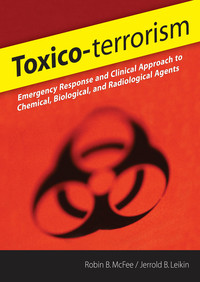
Toxico-terrorism: Emergency Response and Clinical Approach to Chemical, Biological, and Radiological Agents Authors: Robin McFee and Jerrold Leikin

$125,000.00

Descripción

  • Editorial ‏ : ‎ McGraw Hill / Medical; 1er edición (3 Septiembre 2007)
  • Idioma ‏ : ‎ Inglés
  • Tapa blanda ‏ : ‎ 622 páginas
  • ISBN-10 ‏ : ‎ 0071471863
  • ISBN-13 ‏ : ‎ 978-0071471862
  • Dimensiones ‏ : ‎ 8.75 x 1 x 10.75 pulgadas


Book description:

The emergency medicine expertise you need to prepare for–and manage–any type of bioterrorist attack!Written by emergency room physicians for emergency room physicians, Toxico-terrorism covers every essential aspect of the emergency medical response to microbial, radiological, and chemical agents of terrorism. Turn to any page, and you’ll find lifesaving clinical strategies for the management of patients who have been exposed to a biologic, chemical, or nuclear agent.

Features

  • A logical, building-block organization filled with key tables and synoptic boxes
  • Important coverage of pre-hospital and EMS issues
  • Insights into the means of transmission, the modes of dispersal, and how secondary infection and/or contamination can occur
  • Overview of bioterror-specific signs and symptoms
  • A section on emergency department preparedness that reviews critical topics such as nursing triage, hospital/facility security, pharmacy preparedness, and hospital staff issues
  • Up-to-date information on labs, microscopy, and radiology
  • Key diagnostic criteria for all agents
  • Thorough coverage of treatment strategies for all agents discussed in the book
  • Infection control modalities
  • Survey of prophylaxis strategies
  • Valuable section on public health considerations


Robin B. McFee, DO, MPH, FACPM, Assistant Professor, Department of Preventive Medicine SUNY/Stony Brook Assistant Professor, Department of Medicine NYCOM, New York Institute of Technology Toxicologist, Long Island Regional Poison Information Center Winthrop University Hospital Mineola, New York Medical Director, Threat Science

Jerry B. Leikin, MD, FABMT, FACEP, FACMT, FAACT, FACOEM, Director of Medical Toxicology Evanston Northwestern Healthcare–OMEGA Glenbrook Hospital Glenview, Illinois Professor of Emergency Medicine Feinberg School of Medicine Northwestern University Professor of Medicine, Pharmacology, and Health Systems Management Rush Medical College Chicago, Illinois

    Table of Contents
  • Contents
  • Contributors
  • Preface
  • Acknowledgments
  • Part l: General Patient Principles
  • 1 Toxidrome Recognition
  • 2 Biodromes—Bioweapon Recognition
  • 3 Countermeasures and Facility Preparedness: An Overview
  • 4 Supportive Care
  • 5 Dermal Issues
  • 6 Neurologic Issues in Emergency Bioterrorism
  • 7 Cardiac Issues
  • 8 Musculoskeletal Manifestations of Bioterrorism
  • 9 Ophthalmological Issues
  • 10 Respiratory and Critical Care Unit Issues
  • 11 Gastrointestinal and Hepatic Issues
  • 12 Acute Psychiatric Issues
  • 13 Palliative and Expectant (Black Tag) Care
  • 14 Special Populations: Pediatrics
  • 15 Geriatrics: Bioterrorism, Emerging Threats, and Emergency Preparedness: Special Considerations for Geriatric Patients
  • 16 Special Populations: Women Who are Pregnant
  • 17 Women’s Reproductive Issues
  • 18 Hospital Laboratory Issues
  • Part II: EMS Issues
  • 19 Chempack
  • 20 Approach to Disaster and Mass Casualty Incidents
  • 21 Hazardous Materials (Hazmat) Emergencies
  • 22 Enhancing Hospital Emergency Preparedness
  • 23 EMS-ED Considerations
  • 24 Field Identification and Decontamination of Toxins
  • Part III: Emergency Department Preparedness
  • 25 Triage in the Emergency Department
  • 26 Pharmacy Preparedness for Incidents Involving Nuclear, Biological, or Chemical Weapons
  • 27 Hospital Staff Issues
  • Part IV: Specific Chemical Agent: Toxins/Toxicants
  • 28 Nerve Agents
  • 29 Blister Agents
  • 30 Chemical Asphyxiants
  • 31 Flammable Industrial Liquids and Gases
  • 32 Corrosive Industrial Agents
  • 33 Arsenic, Lead, and Mercury
  • 34 Pulmonary Agents
  • 35 Pesticides
  • 36 Nonlethal Weapons or Incapacitating Agents
  • 37 Other Chemical Agents
  • Part V: Biologicals
  • 38 CDC Category Explanation (A, B, C) Overview
  • 39 Anthrax
  • 40 Yersinia Pestis—Plague
  • 41 Botulism
  • 42 Smallpox (Variola) and Poxviruses
  • 43 Tularemia
  • 44 Hemorrhagic Fever
  • 45 CDC Category B Agents
  • 46 CDC Category C Agents
  • 47 Emerging Pathogens
  • 48 Avian Influenza
  • 49 SARS: Severe Acute Respiratory Syndrome
  • 50 Agroterrorism
  • Part VI: Ionizing Radiation
  • 51 A Practical Basis for Early Management of Radiologically Injuredor Ill Patients: Ionizing Radiation Physics and Instrumentation, Radiation Protection, Contamination Control, Dosimetry, and Radiological/Nuclear (R/N) Terrorism
  • 52 Diagnosis and Medical Management of Radiation Injuries and Illnesses
  • Part VII: Explosives/Incendiaries
  • 53 Medical Management of Explosives
  • Part VIII: Public Health Considerations
  • 54 Poison Information Centers
  • 55 Biosurveillance
  • 56 Vaccines
  • Appendix A: CDC Chemical Emergencies: Overview
  • Appendix B: CDC Laboratory Preparedness for Emergencies: Response to Suspicious Substances
  • Appendix C: CDC Laboratory Preparedness for Emergencies: Facts about the Laboratory Response Network
  • Appendix D: CDC Laboratory Preparedness for Emergencies: Laboratory Network for Biological Terrorism
  • Appendix E: CDC Specimen-Collection Protocol for a Chemical-Exposure Event
  • Appendix F: Centers for Disease Control and Prevention Shipping Instructions for Specimens Collected from People Who may have been Exposed to Chemical-Terrorism Agents: Collecting Specimens
  • Appendix G: Continuation Guidance–Budget Year Four, Focus Area D: Laboratory Capacity–Chemical Agents
  • Appendix H: Instructions for Shipping Blood Samples to CDC after a Chemical-Exposure Event
  • Appendix I: Instructions for Shipping Urine Samples to CDC after a Chemical-Exposure Event
  • Appendix J: Sentinel Laboratory Guidelines for Suspected Agents of Bioterrorism: Clinical Laboratory Bioterrorism Readiness Plan
  • Appendix K: Riot Control Agents
  • Appendix L: Chlorine Use as a Weapon
  • Appendix M: Intentional Use of Radiation as a Poison
  • Index


Keywords:BIOTERRORISM, PREPAREDNESS, BIOLOGIC, CHEMICAL, NUCLEAR, RADIOLOGICAL, MICROBIAL, CONTAMINATION, PRE-EXPOSURE, POST-EXPOSURE, ANTIBIOTICS, ANTIVIRALS, ANTITOXINS, BIO-TERROR

Valoraciones

No hay valoraciones aún.

Sé el primero en valorar “Toxico-terrorism: Emergency Response and Clinical Approach to Chemical, Biological, and Radiological Agents Authors: Robin McFee and Jerrold Leikin”

Tu dirección de correo electrónico no será publicada. Los campos obligatorios están marcados con *