
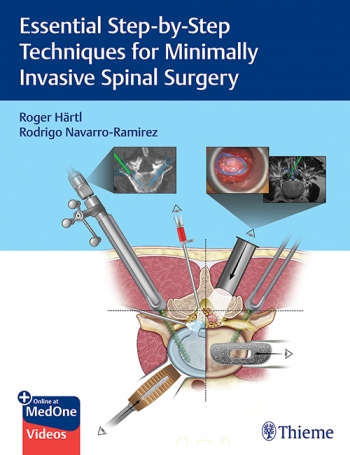
Descripción
Publication Date: June 2022 (Pre-Order)
Edition: 1
Pages: 384
Illustrations: 375
Format: Hardback
ISBN: 9781684200092
The ultimate resource for learning and mastering minimally invasive spine surgery techniques
An estimated 1.5 million instrumented spinal procedures are performed every year in the US. The majority of decompressions and about 50% of fusion procedures can be performed completely or partially using minimally invasive spine surgery (MISS) techniques.
The full potential of MISS techniques has yet to be realized. Essential Step-by-Step Techniques for Minimally Invasive Spinal Surgery by internationally renowned MISS neurosurgeon Roger Härtl, spine-neurosurgeon Rodrigo Navarro-Ramirez, and an impressive group of global multidisciplinary contributors is the most comprehensive and detailed textbook written to date on this topic.
The foundation of the book is built on six interacting principles critical to surgical success, and MISS in particular: Target, Technology, Technique, Teaching and Training, Testing, and Talent.
The text starts with an opening chapter on the definition of MISS and introduction of these principles.
Fifty-six subsequent chapters provide a comprehensive discussion on how to utilize an MISS approach for a full spectrum of spinal pathologies using nuanced variations specific to the operating surgeon. To ensure readers are well versed in all aspects of MISS, these chapters include painstaking details on indications, contraindications, pathoanatomy, operating room set-up, step-by-step techniques, and postoperative management.
Key Highlights
Contributions from master spine surgeons across the world provide a balanced global perspective on mastering and incorporating diverse techniques into practice
Invaluable clinical pearls including tips/tricks and complication avoidance
High-quality images, figures, anatomic drawings, and imaging studies illustrate relevant anatomic approaches and corridors and delineate why anatomic mastery is critical to MISS
Twenty-five videos enhance the ability to learn and implement MISS approaches
This is a must-have resource for practicing spine surgeons interested in MISS who wish to learn the latest techniques from master surgeons and achieve optimal patient outcomes.
The text and videos also provide a robust training tool for senior-level orthopaedic and neurosurgery residents and spine fellows.
This print book includes complimentary access to a digital copy on https://.thieme.com
Table of Contents
Introduction to MISS
Chapter 1: Definition of MISS: The «6Ts»: Target / Technology / Technique / Teaching & Training / Testing / Talent
Chapter 2: Global MIS: Perspectives from Asia, Australia, Europe, Middle East, North America, and South America
MISS Target
Chapter 3: Target Philosophy in Degenerative Spinal Disorders: Correlation of Clinical Presentation, Physical Examination, and Response to Interventional Procedures
Chapter 4: Deformity and MIS: Limitation or Opportunity?
Chapter 5: Target: The Muscle as a Pain Generator and Key Element to Protect During MIS Surgery
MISS Technology
Chapter 6: Tubular and Specular Retractors in Minimally Invasive Spine Surgery
Chapter 7: Navigation in MISS
Chapter 8: Robotics: Background, Current Role
Chapter 9: Microscope in MISS
Chapter 10: Endoscope in MISS: How to Adopt and Change
MISS Techniques
Chapter 11: Three Surgical Principles of MIS: Contralateral Decompression, Minimize Instability, Indirect Decompression
Chapter 12: Surgical Techniques and Instrumentation in MISS
Chapter 13: Dural Repair in MISS, CSF leak management
Chapter 14: How to achieve a successful fusion with MIS techniques
Chapter 15: Surgical Tips, Tricks, Techniques to Minimize Invasiveness; General Advice on How to Handle Fluoroscopy, Blood Loss and Infection Rates
Chapter 16: Perioperative Management; ERAS
Chapter 17: Key Elements to Safely Transition from Inpatient to Outpatient Spine Surgery
Chapter 18: 10 steps: Posterior Cervical Foraminotomy / Discectomy
Chapter 19: 10 Steps: Unilateral Tubular Over-the-Top Cervical Laminectomy for Cervical Stenosis
Chapter 20: 10 Steps: Posterior Cervical Facet Cages DTRAX
Chapter 21: MIS Endoscopic Approaches For Oc-C1-C2 Pathology
Chapter 22: 10 steps: Posterior muscle sparing approaches for decompression, laminoplasty, and laminectomy
Chapter 23: 10 Steps: MIS C1/2 fusion
Chapter 24: Cervical Three-Dimensional Navigation to Facilitate Minimally Invasive Spine Surgery
Chapter 25: Thoracic Vertebroplasty and Kyphoplasty
Chapter 26: Thoracic Discectomy: Posterior Transpedicular Tubular Approach
Chapter 27: Lateral Retropleural Thoracic Discectomy and Corpectomy
Chapter 28: Mini-Open Pedicle Subtraction Osteotomy for Deformity Correction
Chapter 29: Posterior Paramedian Endoscopic Thoracic Discectomy
Chapter 30: 10 steps: Transpedicular corpectomy and fusion for metastatic tumor or infection
Chapter 31: Techniques to Decrease the Invasiveness of Thoracic Deformity Correction
Chapter 32: 10 steps: Unilateral Lumbar Approach For Over The Top Bilateral Decompression
Chapter 33: Far Lateral Lumbar Discectomies
Chapter 34: 10 Steps: Percutaneous Endoscopic Interlaminar Approach For Lumbar Pathologies: Disc Herniation And Lumbar Spinal Stenosis
Chapter 35: Transforaminal Approach Endoscopic Decompression
Chapter 36: Endoscopic Interlaminar Lumbar Laminectomy
Chapter 37: 10 Steps: LLIF T12L1
Chapter 38: 10 steps: LLIF L2/3/4/5
Chapter 39: Translumbar Surgery Comparison 4 Surgeons and Regions
Chapter 40: 10 Steps: Minimally Invasive Oblique anterior Lumbar Interbody
Fusion (OLIF)
Chapter 41: Maximum Access Posterior Lumbar Interbody Fusion (MAS PLIF)
Chapter 42: MIS-TLIF
Chapter 43: MIS-TLIF Comparison 4 Surgeons and Regions
Chapter 44: Percutaneous Pedicle Screw Fixation And MISS SI Joint Fusion
Chapter 45: Intradural Extramedullary Tumors
Chapter 46: 3D Navigation In Lumbar Spine To Facilitate Minimally Invasive Spine Surgery (MISS)
Chapter 47: Strategies to Minimize Invasiveness and Optimize Success: OC Fusion
Chapter 48: Strategies To Minimize Invasiveness and Optimize Success: Cervical Front/Back Surgery For Deformity Correction
Chapter 49: 10 Steps: MIS Cervical Pedicle Screws – Percutaneous Assisted Technique
Chapter 50: Treatment of Degenerative Lumbar Scoliosis with Minimally Invasive Multilevel LLIF in combination with Lateral ALIF
Chapter 51: Strategies to minimize invasiveness and optimize success: T10-Pelvis
Chapter 52: Lifestyle Medicine: Optimizing Recovery following MIS of the Spine
Chapter 53: 3D Navigation in MISS
MISS: Teaching & Training / Future
Chapter 54: Teaching and Training: Surgical training and simulation in MISS
Chapter 55: The Role of Biologics in MIS Surgery
Chapter 56: Summary and Outlook – Future of Lumbar Minimally Invasive Surgery (MIS)
Chapter 57: Achieving MISS on a Global Level
Thieme Medical Publishers es una editorial médica y científica alemana del Thieme Publishing Group. Produce revistas profesionales, libros de texto, atlas, monografías y libros de referencia en alemán e inglés que cubren una variedad de especialidades médicas




Valoraciones
No hay valoraciones aún.