
Descripción
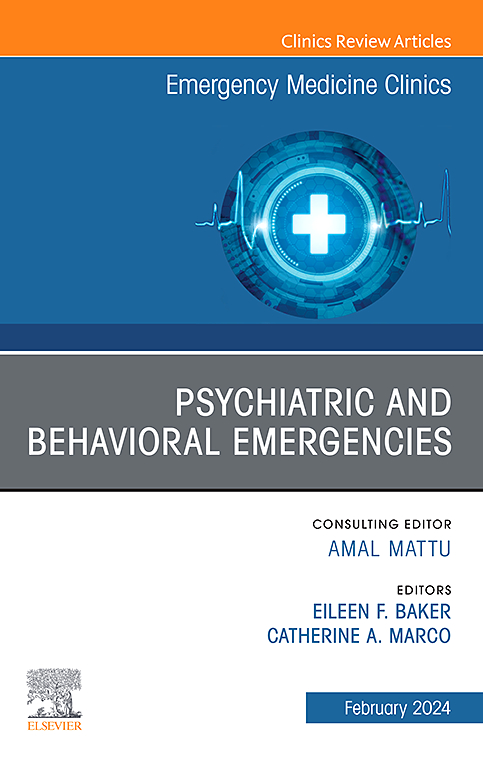
In this issue of Emergency Medicine Clinics, guest editors Drs. Eileen F. Baker and Catherine A. Marco bring their considerable expertise to the topic of Psychiatric and Behavioral Emergencies. Top experts cover key topics such as the emergency psychiatric interview; the agitated patient; the suicidal or homicidal patient; excited delirium; substance use disorders; schizophrenia; depression; and more.
Key Features
- Contains 15 relevant, practice-oriented topics including bipolar affective disorder; geriatric and pediatric psychiatric emergencies; personality disorders; malingering; legal and ethical considerations; and more.
- Provides in-depth clinical reviews on psychiatric and behavioral emergencies, offering actionable insights for clinical practice.
- Presents the latest information on this timely, focused topic under the leadership of experienced editors in the field. Authors synthesize and distill the latest research and practice guidelines to create clinically significant, topic-based reviews.
Author Information
Edited by Eileen F. Baker, MD, PhD, University of Toledo College of Medicine and Life Sciences, Toledo, OH and Catherine Anna Marco, MD, Associate Professor, Medical College of Ohio, Toledo, OH
Contents
Foreword: Psychiatric and Behavioral Emergencies xiii
Amal Mattu
Preface: Essentials of Psychiatric and Behavioral Emergencies xv
Eileen F. Baker and Catherine A. Marco
The Emergency Psychiatric Interview 1
Ina Becker
A quality clinical interview helps establish a good collaborative relationship
with the patient. This is especially important when emergency physicians
conduct a psychiatric interview. Familiarity with interview techniques, empathic
listening, and observation of nonverbal cues, behavior, and appearance
enhance diagnostic excellence.
Management of the Agitated Patient 13
Carmen Wolfe and Nicole McCoin
The acutely agitated patient should be managed in a step-wise fashion,
beginning with non-coercive de-escalation strategies and moving on to
pharmacologic interventions and physical restraints as necessary. Faceto-
face examination, monitoring, and documentation by the physician
are essential. The emergency physician should be familiar with multiple
pharmaceutical options, tailored to the individual patient. Use of ketamine,
benzodiazepines and antipsychotics should be considered. Patient
autonomy, safety, and medical well-being are paramount.
Emergency Department Care of the Patient with Suicidal or Homicidal Symptoms 31
Chadd K. Kraus and James Ferry
Patients frequently present to the emergency department (ED) with acute
suicidal and homicidal thoughts. These patients require timely evaluation,
with determination of disposition by either voluntary or involuntary
hospitalization or discharge with appropriate outpatient follow-up. Safety
concerns should be prioritized for patients as well as ED staff. Patient
dignity and autonomy should be respected throughout the process.
Hyperactive Delirium with Severe Agitation 41
Brian Springer
Hyperactive delirium with severe agitation is a clinical syndrome of altered
mental status, psychomotor agitation, and a hyperadrenergic state. The
underlying pathophysiology is variable and often results from sympathomimetic
abuse, psychiatric disease, sedative-hypnotic withdrawal, andperiarrest
with little warning. Safety of the patient and of the medical providers is
paramount and the emergency department should be prepared to manage
these patients with adequate staffing, restraints, and pharmacologic sedatives.
Treatment with benzodiazepines, antipsychotics, or ketamine is
recommended, followed by airway protection, supportive measures, and
cooling of hyperthermia.
Substance Use Disorder 53
Kaitlyn R. Swimmer and Stephen Sandelich
Substance use disorders (SUDs) present a challenge in the emergency department
(ED) setting. This article provides an overview of SUDs, their clinical
assessment, legal considerations in drug testing, diagnosis, and
treatment approaches. SUDs are prevalent and coexist with mental health
disorders, necessitating comprehensive evaluation and management.
Clinical assessment involves screening tools, substance use history, and
identification of comorbidities. Diagnosis relies on a thorough evaluation
of substance abuse patterns and associated medical conditions. Treatment
approaches encompass a multidisciplinary approach, incorporating
counseling, medications, and social support. Effective management of
SUDs in the ED requires a comprehensive understanding of these complex
disorders.
Physiologic Effects of Substance Use 69
Brian Patrick Murray and Emily Anne Kiernan
Physiologic and psychological effects of substance use are common occurrences.
They may be the proximate purpose of the exposure or related
to an unintended complication. Acute short-term exposure effects may
not be the same as long-term effects. These effects are mediated by
different receptors they act on and the homeostatic changes that occur
due to repeat exposure. We review in this article the physiologic and psychological
effects from exposure to commonly encountered drugs, ethanol,
sedative hypnotics, cocaine, amphetamines, marijuana, opioids,
nicotine, hydrocarbons (halogenated and non-halogenated), and nitrous
oxide.
Schizophrenia and Emergency Medicine 93
Ryan E. Lawrence and Adam Bernstein
Schizophrenia is a chronic condition characterized by positive symptoms
(auditory hallucinations, delusion), negative symptoms (avolition, social
withdrawal), and disorganized thoughts/behaviors. Although the pathophysiology
is incompletely understood, several neurobiological mechanisms
have been proposed. Treatment usually involves antipsychotic
medication as well as psychotherapy and supportive services. When evaluating
patients in the emergency department, acute safety considerations
are paramount. Patients should be assessed for suicide risk, violence risk,
inability to care for self, and the risk of being the victim of a crime. Persons
with schizophrenia are at an increased risk of substance use and a variety
of medical problems.
Overview of Depression 105
Samantha Chao
Depressive disorders encompass a spectrum of diagnoses and are more
common in women and transgender individuals. Diagnosis involves thorough
history-taking and exclusion of underlying medical disorders. The
emergency physician should assess the risk of self-harm and consider environmental
and social factors prior to disposition.
Bipolar Disorders in the Emergency Department 115
Carmen Wolfe and Nicole McCoin
Affective disorders affect the way that people think and feel and are classified
into unipolar disorders and bipolar disorders. Bipolar disorders represent
a spectrum of these chronic mental health illnesses. Patients with
bipolar disorder have high recurrence of acute symptoms, and on average
spend 20% of their life in exacerbations characterized by mania, depression,
or psychosis. Given the increased morbidity and mortality associated
with bipolar disorders, it is imperative that the emergency physician remain
vigilant when these patients seek emergency care.
Recognizing and Responding to Patients with Personality Disorders 125
Jillian L. McGrath and Maegan S. Reynolds
Caring for patients with personality disorders and traits presents unique
challenges for physicians and other providers. The Diagnostic and Statistical
Manual of Mental Disorders, Fifth Edition, recognizes 10 personality
disorders, which are organized into 3 clusters (A, B, and C) based on
shared diagnostic features. Personality disorders or traits create difficulty
in clinical and interpersonal interactions, promoting missed diagnosis or
underdiagnosis, nonadherence to medical recommendations, or other
dangerous outcomes. It is important to recognize patients with potential
personality disorders and understand strategies to achieve optimal patient
interactions and best possible medical outcomes.
Geriatric Psychiatric Emergencies 135
Michelle A. Fischer and Monica Corsetti
Geriatric patients, those 65 years of age and older, often experience psychiatric
symptoms or changes in mentation as a manifestation of an organic
illness. It is crucial to recognize and treat delirium in these patients
as it is often under-recognized and associated with significant morbidity.
Iatrogenic causes of altered mentation or delirium due to medication adverse
reactions are common. Treatment of the underlying cause, creating
an environment conducive to orientation, and minimizing agitation and discomfort
are first-line interventions. Antipsychotics are first-line pharmacologic
interventions if needed to preserve patient safety.
Pediatric Psychiatric Emergencies 151
Purva Grover and Manya Kumar
Pediatric psychiatric emergencies account for 15% of emergency department
visits and are on the rise. Psychiatric diagnoses in the pediatric population
are difficult to make, due to their variable presentation, but early diagnosis
and treatment improve clinical outcome. Medical reasons for the patient’s
presentation should be explored. Both physical and emotional
safety must be ensured. A multidisciplinary approach, utilizing local primary
care and psychiatric resources, is recommended.
Eating Disorders 163
Diane L. Gorgas
Anorexia nervosa (AN) and bulimia nervosa (BN) are easily missed in the
emergency department, because patients may present with either low,
normal, or increased BMI. Careful examination for signs of purging and excessive
use of laxatives and promotility agents is important. Careful examination
for and documentation of dental erosions, posterior oropharyngeal
bruising, Russel’s sign, and salivary and parotid gland inflammation are
clues to the purging behavior. Treatment for AN should include cognitive
behavioral therapy with concomitant efforts to treat any psychiatric comorbidities,
whereas BN and BED have been successfully treated with fluoxetine
and lisdexamfetamine, respectively.
Difficult Patients: Malingerers, Feigners, Chronic Complainers, and Real Imposters 181
Artun K. Kadaster, Markayle R. Schears, and Raquel M. Schears
Malingering is the intentional production of false or grossly exaggerated
symptoms motivated by internal and external incentives. The true incidence
of malingering in the emergency department is unknown because
of the difficulty of identifying whether patients are fabricating their symptoms.
Malingering is considered a diagnosis of exclusion; a differential diagnosis
framework is described to guide emergency physicians. Several
case studies are presented and analyzed from a medical ethics perspective.
Practical recommendations include use of the NEAL (neutral, empathetic,
and avoid labeling) strategy when caring for patients suspected of
malingering.
Legal and Ethical Considerations in Psychiatric Emergencies 197
Jay M. Brenner and Thomas E. Robey
Individual rights can be limited in the context of psychiatric emergencies.
The emergency physician should be familiar with state laws pertaining to
involuntary holds. Physicians are equipped to perform a medical screening
examination, address mental health concerns, and lead efforts to de-escalate
agitation. The physician should conduct a thorough assessment and
distinguish between malingering and mental health decompensation,
when appropriate.



Valoraciones
No hay valoraciones aún.