
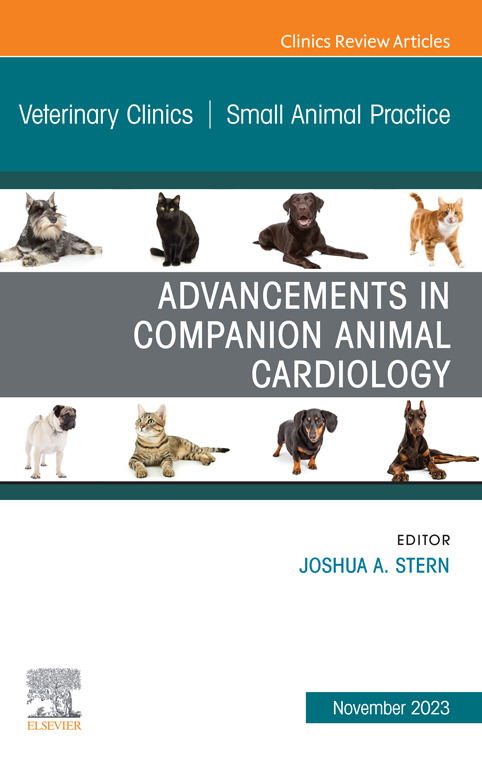
Descripción
Preface: Exciting Advancements and Compelling Future Directions in Companion Animal Cardiology xiii
Joshua A. Stern
The Role of Personalized Medicine in Companion Animal Cardiology 1255
Victor N. Rivas, Joshua A. Stern, and Yu Ueda
Cardiomyopathies remain one of the most common inherited cardiac diseases in both human and veterinary patients. To date, well over 100 mutated genes are known to cause cardiomyopathies in humans with only a handful known in cats and dogs.
This review highlights the need and use of personalized one-health approaches to cardiovascular case management and advancement in pharmacogenetic-based therapy in veterinary medicine. Personalized medicine holds promise in understanding the molecular basis of disease and ultimately will unlock the next generation of targeted novel pharmaceuticals and aid in the reversal of detrimental effects at a molecular level.
Predicting Development of Hypertrophic Cardiomyopathy and Disease Outcomes in
Cats 1277
Jose Novo Matos and Jessie Rose Payne
Echocardiography is the gold standard imaging modality to diagnose hypertrophiccardiomyopathy (HCM) in cats. Echocardiographic features can predict both cats at an increased risk of developing HCM and cats with HCM at an increased risk of developing cardiovascular events or experiencing cardiac death.
Left atrial dysfunction seems to be an important feature of HCM, as it is an early phenotypic abnormality and is also associated with worse outcome.
Advancing Treatments for Feline Hypertrophic Cardiomyopathy: The Role of Animal Models and Targeted Therapeutics 1293
Joanna L. Kaplan, Victor N. Rivas, and David J. Connolly
Feline HCM is the most common cardiovascular disease in cats, leading to devastating outcomes, including congestive heart failure (CHF), arterial thromboembolism (ATE), and sudden death.
Evidence demonstrating long-term survival benefit with currently available therapies is lacking.
Therefore, it is imperative to explore intricate genetic and molecular pathways that drive HCM pathophysiology to inspire the development of novel therapeutics. Several clinical trials exploring new drug therapies are currently underway, including those investigating small molecule inhibitors and rapamycin. This article outlines the key work performed using cellular and animal models that has led to and continues to guide the development of new innovative therapeutic strategies.


Valoraciones
No hay valoraciones aún.